

On October 5, 2026, the last phase of Quebec's Bill 29 came into force. One year earlier, to the day, it was the first. Two dates, two new obligations for every reseller who sells to consumers, and a single reaction across the industry: minimal compliance, when there is any.
That's normal. A law is something you put up with. You read what has to be displayed, you display it, you move on.
Except that every upheaval is an opportunity. When the rules change for everyone at the same time, whoever reads them differently gets a head start, and gets it for free. Bill 29 contains two such opportunities for IT resellers. The first lets you display, right next to every price, exactly what sets you apart from the big-box stores. The second forces you to talk about warranties with every customer, and therefore to sell what almost nobody sells.
For a year, I have watched what resellers do with it. Almost nothing. Here is why that is your chance.
What just came into force, and what already was
Two warranties, two dates. This is not legal advice; it is the summary you need for what follows.
Since October 5, 2025: the availability warranty. Replacement parts, repair services and the information needed for maintenance or repair must be available for a reasonable time, at a reasonable price. The merchant and the manufacturer may opt out, in whole or in part, on one condition: telling the consumer before the sale. For the merchant, that means a notice next to the price, in store and online, product by product. A general page in the footer does not meet this obligation. And the law explicitly provides for partial availability: you can guarantee all repair services and only some parts, as long as you write it down. Online, you must also provide the link to the manufacturer's information.
Since October 5, 2026: the proper-functioning warranty. A new laptop, desktop computer, tablet or cell phone must work for three years, parts and labour, at no cost to the consumer. This warranty applies automatically, with no registration or form, and it is added to the legal warranty that already existed. The merchant must display its duration next to the price, in an obvious way. And before offering an additional warranty on one of these products, the merchant must hand over a notice that describes the proper-functioning warranty, states that it is granted automatically by law and recalls the other free warranties.
Two display obligations, then, and one obligation to talk about warranties at the moment of sale. Read them a second time, because both are also advertising spaces the law orders you to occupy.
Opportunity 1: the "Not available" that costs you your differentiator
Ask any IT reseller what sets them apart from the big-box stores. The answer arrives before the question is finished: service. We repair. We have a workshop. We are a service centre for the manufacturer. When it can't be fixed here, we handle the shipment to the manufacturer and manage the file for the customer.
All of that is true. I know because I did it for 35 years and because I hear it every week.
Now go to that same reseller's online store and look for the availability warranty notice. In the vast majority of cases, you will find "Not available". Repair services: not available. Parts: not available.
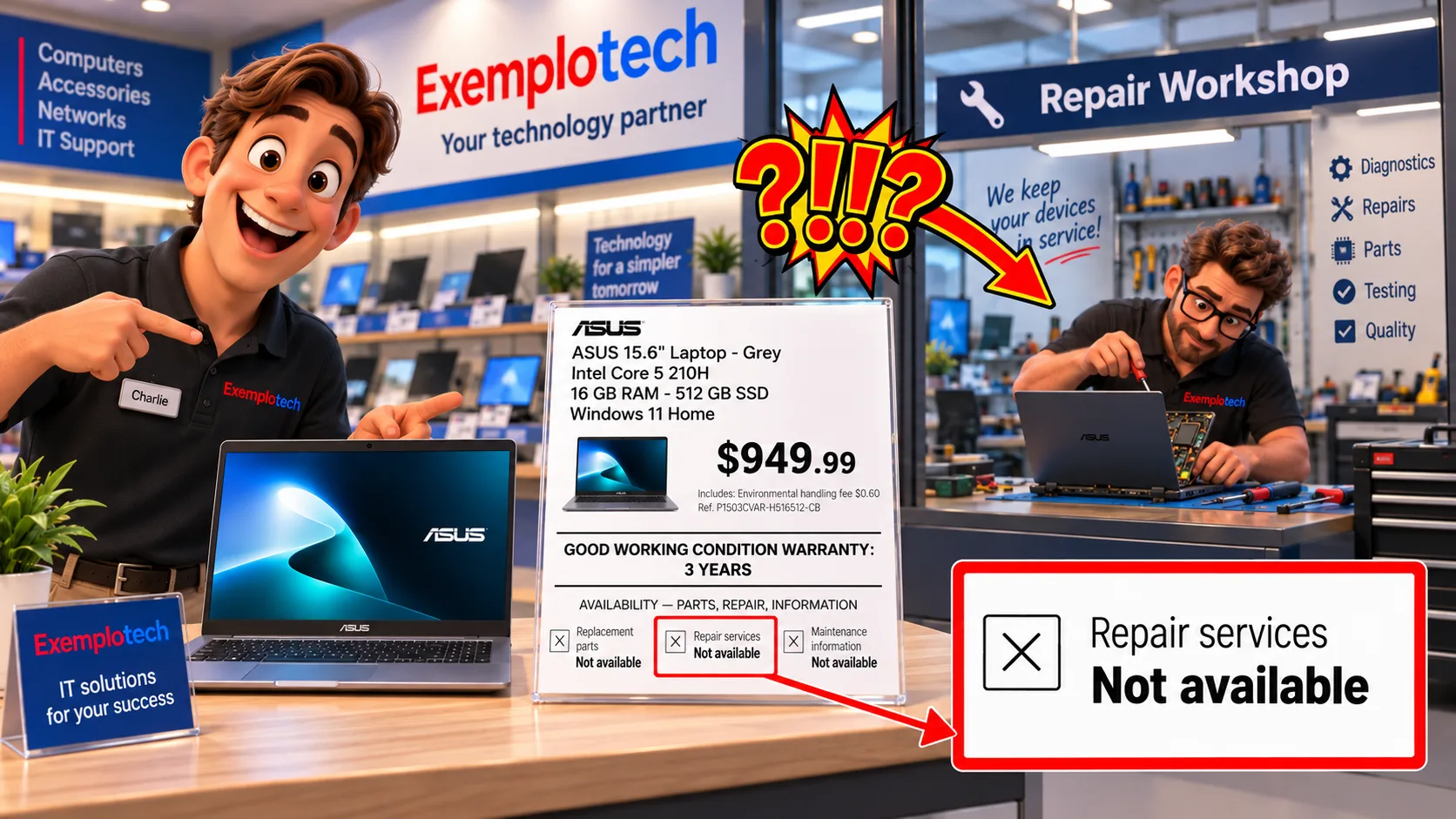
That is what makes me laugh. The government created an obligation to display, next to every price, whether you repair or not. For a big-box store, it is a box where it admits it repairs nothing. For you, it is a box that says "we fix this" at the exact spot the customer looks before buying. The law gave you a free advertising space for your workshop, on every product sheet, and you wrote in it that you have no workshop.
Why? Not out of bad faith. Out of laziness, or simplicity. "Not available" is the easy path: one notice, no nuance, no risk. Except it is no longer even the compliant path. The notice must be next to the price, product by product, and a general sign is no longer enough.
The usual objection is parts: "I can't guarantee every part for every product." Correct, and the law does not ask you to. Partial availability is provided for. You can write that repair services are available and that some parts are not. It is honest, it is compliant, and it tells the customer what they want to know: if it breaks, I can come back here.
On October 5, I checked the websites of a few large resellers. The duration of the proper-functioning warranty, this week's one, was displayed. The availability warranty, last year's one, was relegated to the footer as a general notice. A year later, even the big players are not there. The field is open.
You are on your own
If you are discovering part of the above as you read it, you are not the exception. In my conversations with resellers, the availability warranty is by far the least known part of Bill 29. A year after it came into force, nobody has explained it to you, and nobody is coming to do so.
For the proper-functioning warranty, this week's one, the situation is barely better. Across my entire network, a single manufacturer has sent instructions to its accounts: Lenovo. A representative passed along the procedure for the customer to register their 3-year warranty with Lenovo, with a direct reference to Bill 29. The other manufacturers? Silence.
Let's be fair to Lenovo: for the customer, it is good news. A 3-year warranty recorded in the manufacturer's system, recognized by any service centre, with no arguing, is concretely better than a legal right you have to plead.
But look at who benefits. In three lines, Lenovo makes its own network the repair reflex for the next three years. "Any service centre" means any one of them, not necessarily yours. And this is where the two warranties meet: if, for the availability warranty, your product sheet says "Repair services: not available", you have just confirmed to the customer that they must go elsewhere for their proper-functioning repair.
One manufacturer getting organized, the others staying silent, and a merchant alone with two display obligations and a customer asking what it all means. It is uncomfortable. It is also why it is an opportunity: the first reseller in a region to clearly display "we fix this, here" has no competition on that sentence.
Opportunity 2: the law forces you to talk about warranties. Sell some.
Second finding from my conversations with resellers: practically nobody sells additional warranties. Not by choice, by habit. You sell the machine, hand over the invoice, wish them luck. The manufacturer's extended warranty or a third party's program stays in the catalogue, never on the counter.
That is margin you leave to the manufacturer, to the third party, or to nobody.
The proper-functioning warranty changes one thing: the subject is now on the counter, whether you like it or not. Before offering an additional warranty on a laptop, a tablet or a cell phone, you must hand over a notice explaining the 3-year legal warranty. Many resellers will see one more constraint. Read it differently: the law requires you to have a conversation about warranties with every customer, at the exact moment they take out their wallet. You no longer have to bring up the subject. It is brought up for you.
What it requires is having something to offer when the conversation comes. And with three years guaranteed by default, parts and labour, an additional warranty that only covers defects for three years will no longer sell. Your offer must go where the legal warranty does not: a longer term, accidental damage, on-site service, a loaner device during the repair. The manufacturer and third parties have these products. What remains is to put them into your sales process, and to train the people behind the counter.
That is exactly what we are building at EStaff Plus: a training course on selling additional warranties, complementary to our training on the legal warranty, ready by the end of the year. But you don't need to wait for us to ask the first question: what do I offer, today, to the customer who asks whether they should take out protection?
Your three tasks for the week
If you sell to consumers, here is what I would do before Friday.
1. Ask yourself the real question about repair services. Open your online store, take your best-selling product and read what you display for the availability warranty. If it says "Not available" while you have a workshop, you have just found your differentiator. It was there, waiting for you to write it down.
2. Check every display point. Store, quotes, e-commerce site and marketplaces, if any: for each one, verify that the proper-functioning warranty and the availability warranty are displayed as the law requires, next to the price, product by product. One forgotten channel, and the compliance of the others does not protect you.
3. Decide whether you sell additional warranties. Not "someday". Now, because the conversation will happen at every sale anyway. If the answer is yes, you need an offer and people trained to present it.
At EStaff Plus, we can help on all three points. In our solution, product signs and quotes comply with Bill 29, which takes care of a good part of task 2 without you having to edit every product sheet by hand. To understand and explain the law, we offer two training courses: "Bill 29 Training: Proper-Functioning Warranty – Leader edition", for those who decide on display and the offer, and "Bill 29 Training: Proper-Functioning Warranty – Employee edition", for those who answer the customer at the counter. The training on selling additional warranties will follow by the end of the year.
Bill 29 did not change what you do. It only requires you to write it next to the price. Your competitors wrote "Not available". It is up to you to decide what you write.