Last week, I gave a 10-minute talk at a meeting of the Consortium informatique, on procurement for IT resellers. Since it was a new topic for our meetings, I didn't know which direction to take.
I remembered that I had a backup copy from July 2025. It let me analyze price differences to see how the surge in memory prices is affecting today's market.
While analyzing that data, I made the connection with habits I see at many IT resellers. These habits cost them dearly, even more so in a rising market like today's.
What the study says
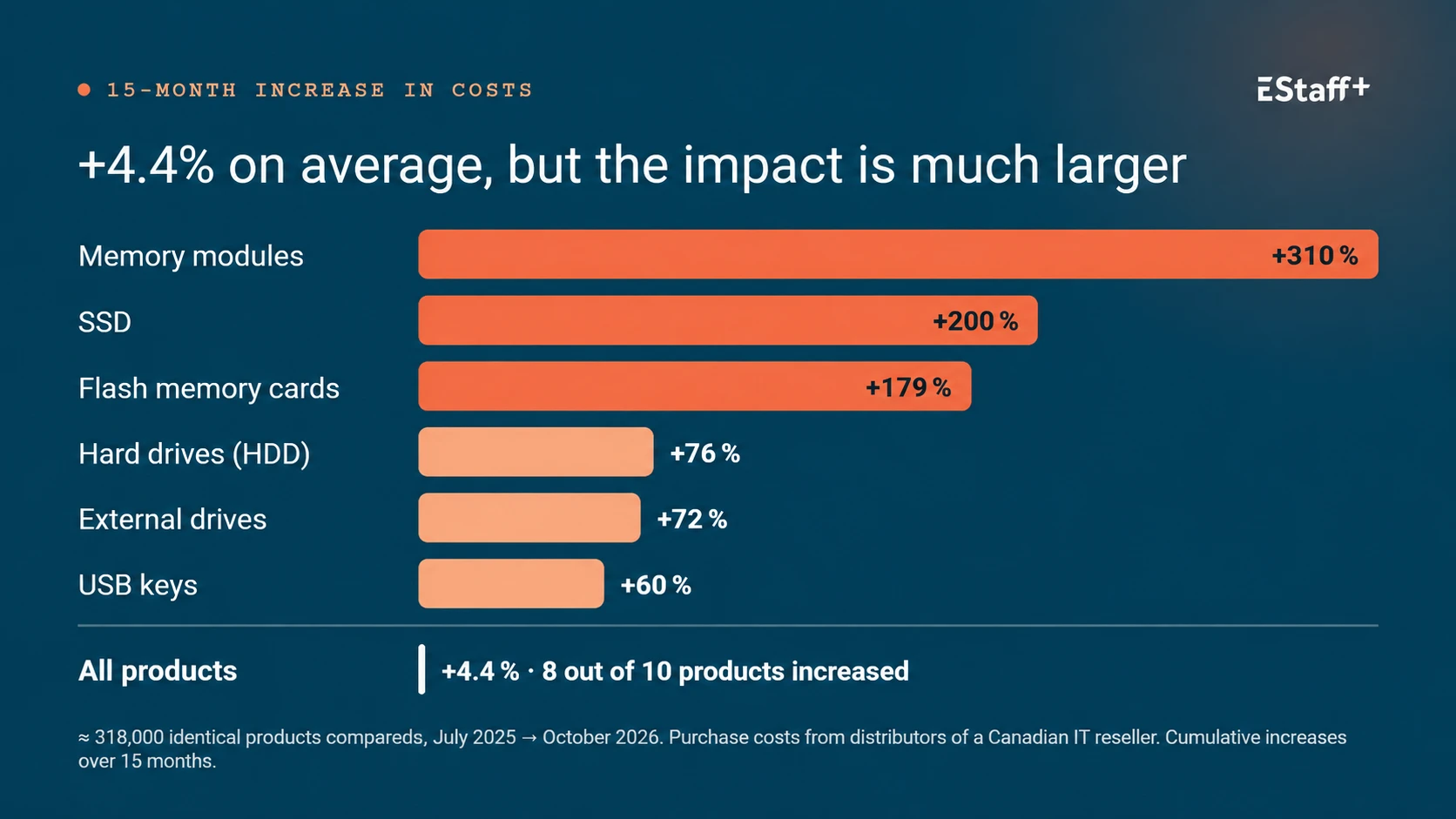
The data. These are the actual distributor costs of a Canadian IT reseller, compared between July 2025 and October 2026, a span of 15 months. It is a sizeable reseller: I estimate it ranks somewhere between 100th and 200th among the 250 largest resellers in Canada. So it already gets aggressive pricing from its distributors.
The scope. I compared roughly 318,000 identical products from one date to the other, out of nearly 1 million active products. I excluded software and services, whose billing units changed, as well as Adobe and costs below $0.05. These are purchase costs, not selling prices.
The overall result. The median cost of the same product rose 4.4% in 15 months, and 8 products out of 10 went up. That modest figure hides big gaps: memory modules rose a median 310% and SSDs 200%. Careful, these are cumulative increases over 15 months, not what you see on a single purchase.
The limit. This is a single source. Since this reseller already gets aggressive pricing, I believe a smaller reseller, with less favourable costs, could face bigger gaps. That is my opinion, not a result of the study. The habits I discuss below also come from my experience in the industry, not from this study.
Habit 1: selling at the price you paid
In December 2025, I saw Facebook posts from resellers inviting their customers to come buy their computer before the inventory was restocked.
These resellers were not selling at a loss. They were selling at the price they had paid one or two months earlier, with their usual margin. But they probably knew that, the day they restocked, they would pay more, and their customers would then have to pay more too.
In my view, they should have taken advantage of the rise to make more profit, in anticipation of the moment the market turns down.
Why it's a mistake: a simple example. You buy a laptop for $1,000 in October and sell it for $1,250, a $250 margin. A month later, if you had to buy it again, your distributor would charge you $1,250. But since you still have some in inventory, you keep selling it at $1,250 instead of $1,500. You leave $250 on the table on every sale.
Flip the situation. When prices fall, you will have a laptop you paid $1,500 for that your distributor would now sell for $1,250. Are you going to sell it for $1,750 (cost plus margin)? Your customer will go elsewhere. You will sell it for $1,500 and eat your margin to move it out.
Result: you never benefit from the rise, but you absorb the fall.
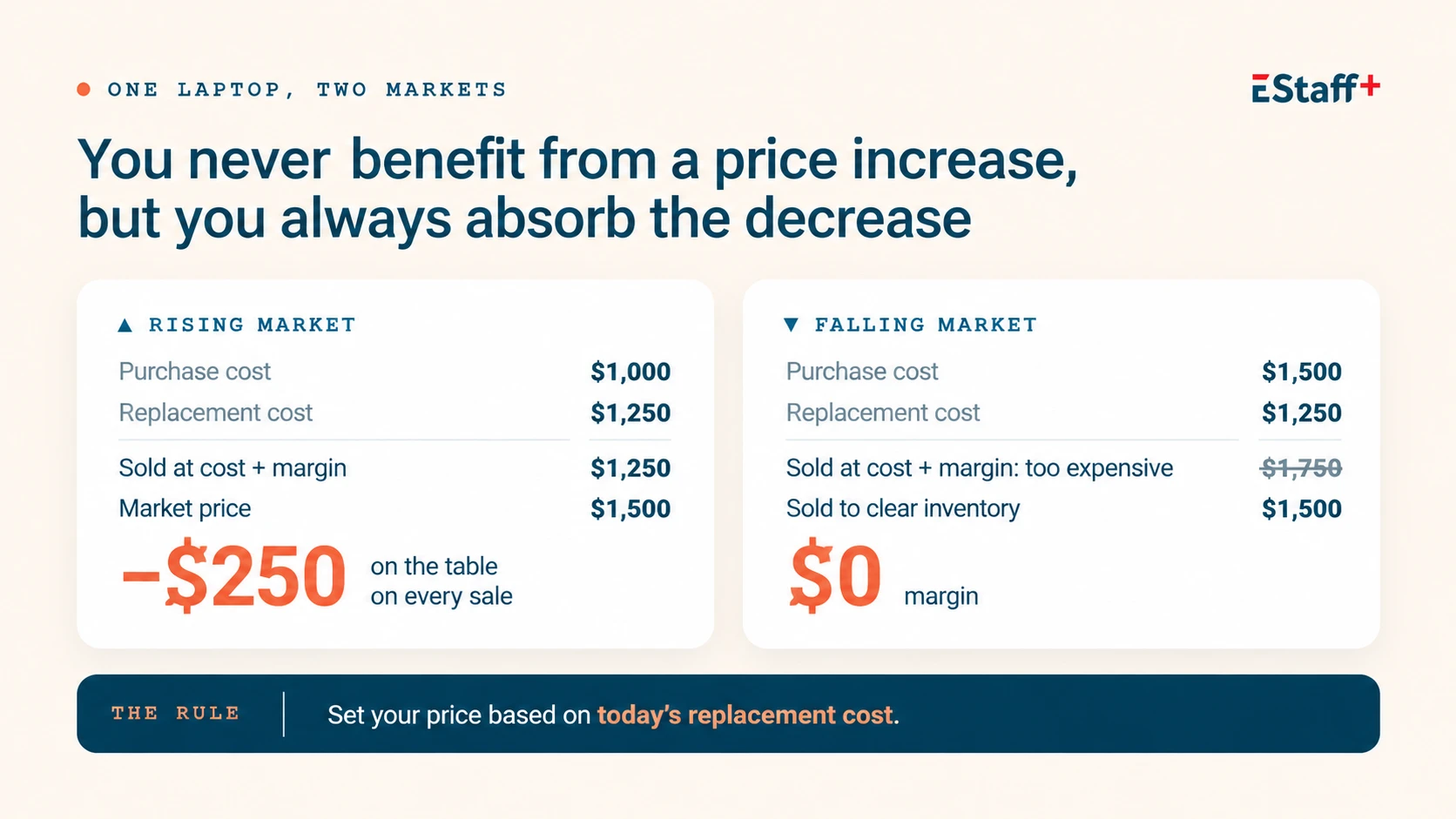
The rule. Set your selling price from today's replacement cost, not from the purchase cost of your inventory. You are not "taking advantage" of your customer: you are selling at the market price, the one your customer would find elsewhere today.
Habit 2: choosing your distributor out of habit
When a major distributor is not the cheapest for a product, it is generally 2 to 4% more expensive (median gap, across the reseller's three main distributors). In a field where an 18% gross margin is already exceptional, that is a significant share of the margin. This 18% margin is my estimate from experience, not a result of the study.
And "the cheapest" changes. Here is the share of products on which each distributor offers the lowest cost:
- Ingram Micro: 64% in July 2025, about 48% in October 2026
- TD Synnex: 30% in July 2025, about 42% in October 2026
- D&H Canada: 40% in July 2025, about 44% in October 2026
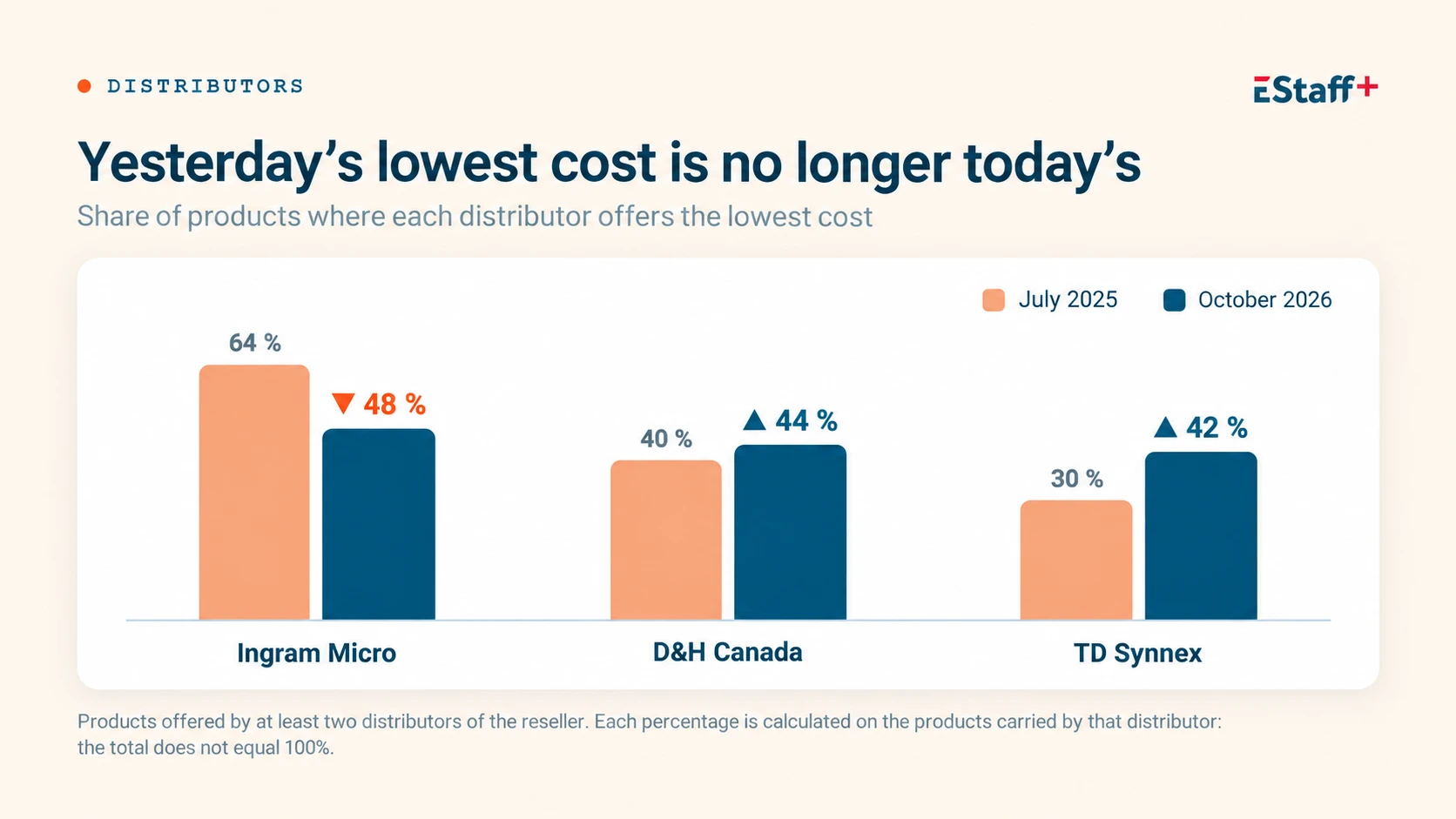
Buying from Ingram by reflex was almost always a good choice 15 months ago. It no longer is.
These percentages do not add up to 100%, because each is calculated on the products that distributor carries, not on the whole market. They only count products offered by at least two of the reseller's distributors, and two costs less than $0.01 apart share the same rank.
Habit 3: quotes that are valid too long
In my experience, a quote is generally valid for 21 to 30 days. In a stable market, that works. In a market where the cost of memory, storage and servers is rising, you commit to a price while your replacement cost moves. The study shows these increases over 15 months (+310% for memory modules, +200% for SSDs), but it does not measure how fast they happen from one week to the next.
My recommendation: a validity of 7 days at most.
For large quotes, also add protection against the exchange rate. It is not an issue right now, but it can become one. A sentence like this is enough: "This quote was prepared when the exchange rate was X. We may revise the price if the rate varies by more than 3%."
Habit 4: calculating prices by hand
Here is what I see most often: the reseller checks their cost at one distributor (or several, when there is time), then calculates the selling price with a calculator and the category margin.
This method has four problems:
- Lack of time. When the customer is on the phone or you are running late, you don't take the time to update the cost.
- A virtual margin table. In practically every case I have seen, it lives in the head of the owner or a few people. Under those conditions, it is hard to apply the right margin.
- A margin that depends on the mood of the moment. Without a written rule, the margin varies from one customer and one day to the next.
- Cumulative time. However you find the cost and the margin, count about 30 seconds per price. By the end of the day, that adds up to several minutes.
Conclusion: what we do starting Monday
The four habits share the same starting point: acting by reflex, with yesterday's cost. Starting Monday, you can:
- Set your prices from today's replacement cost, not from the purchase cost of your inventory.
- Compare your distributors on every significant purchase, because the cheapest one changes.
- Bring the validity of your quotes down to 7 days at most.
- Write down your margin rules, so they no longer live in someone's head.
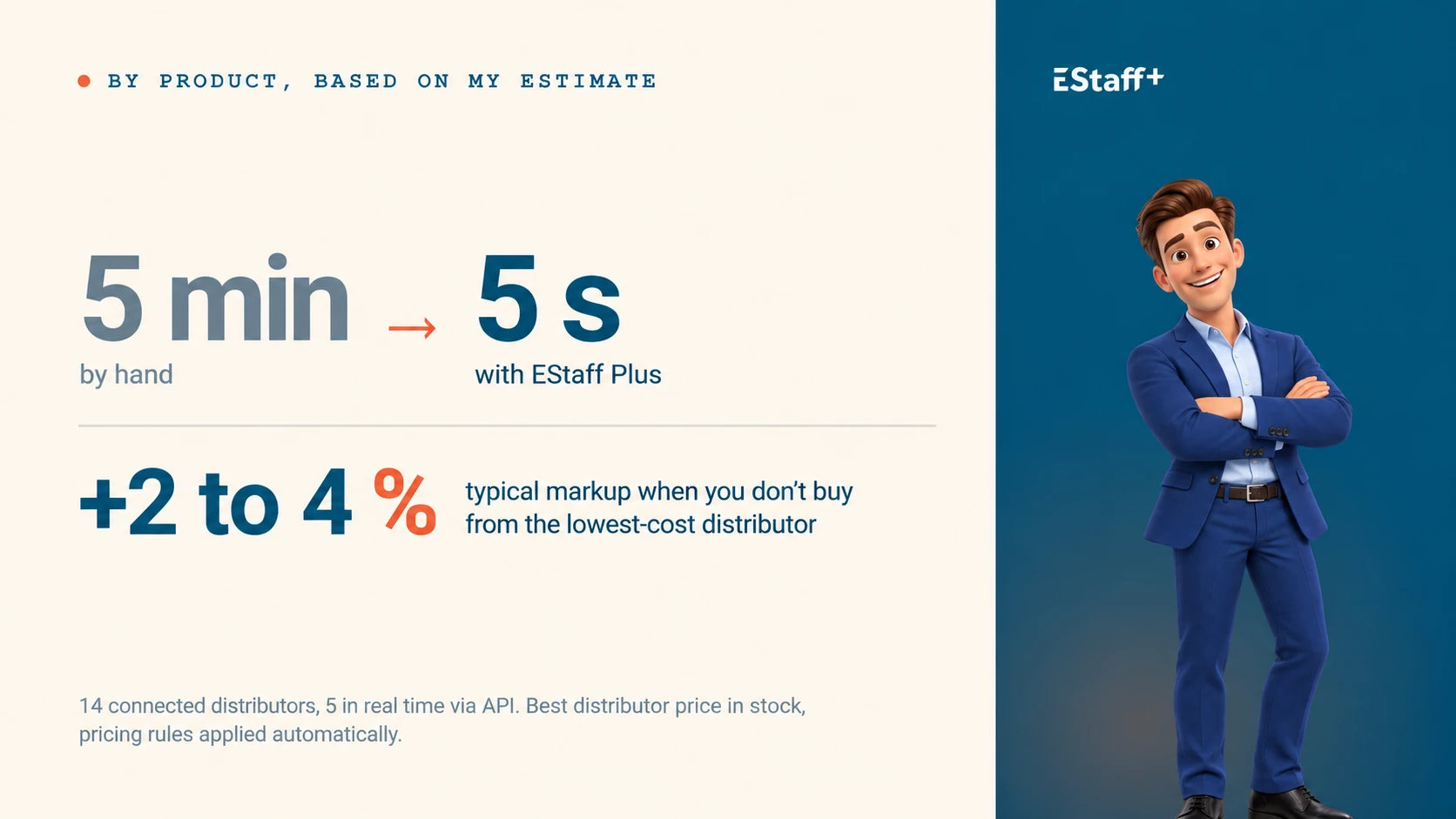
Where EStaff Plus fits in. EStaff Plus is connected to 14 distributors. For five of them, prices and inventory are updated by API on every search. For the others, the information is from last night. The platform directly shows the price of the best distributor that has the product in stock. You set your pricing rules once, and the calculation happens automatically.
By my estimate, you go from about 5 minutes per product (searching a few distributors, picking the best one, calculating the selling price) to about 5 seconds. On top of that, there is a potential 2 to 4% more in your pocket, the typical gap observed when you don't buy from the cheapest.