If your prices are too high, you'll find out quickly: your customers will shop elsewhere. But no customer will ever call to tell you that you're not charging enough.
My speakers at regular price
When I started out as a reseller, I set my prices to the best of my knowledge. I took a 20% margin.
Then I joined a buying group that published a flyer. The manufacturer had given the group a rebate, and the flyer showed that rebate calculated from the manufacturer's suggested retail price (MSRP).
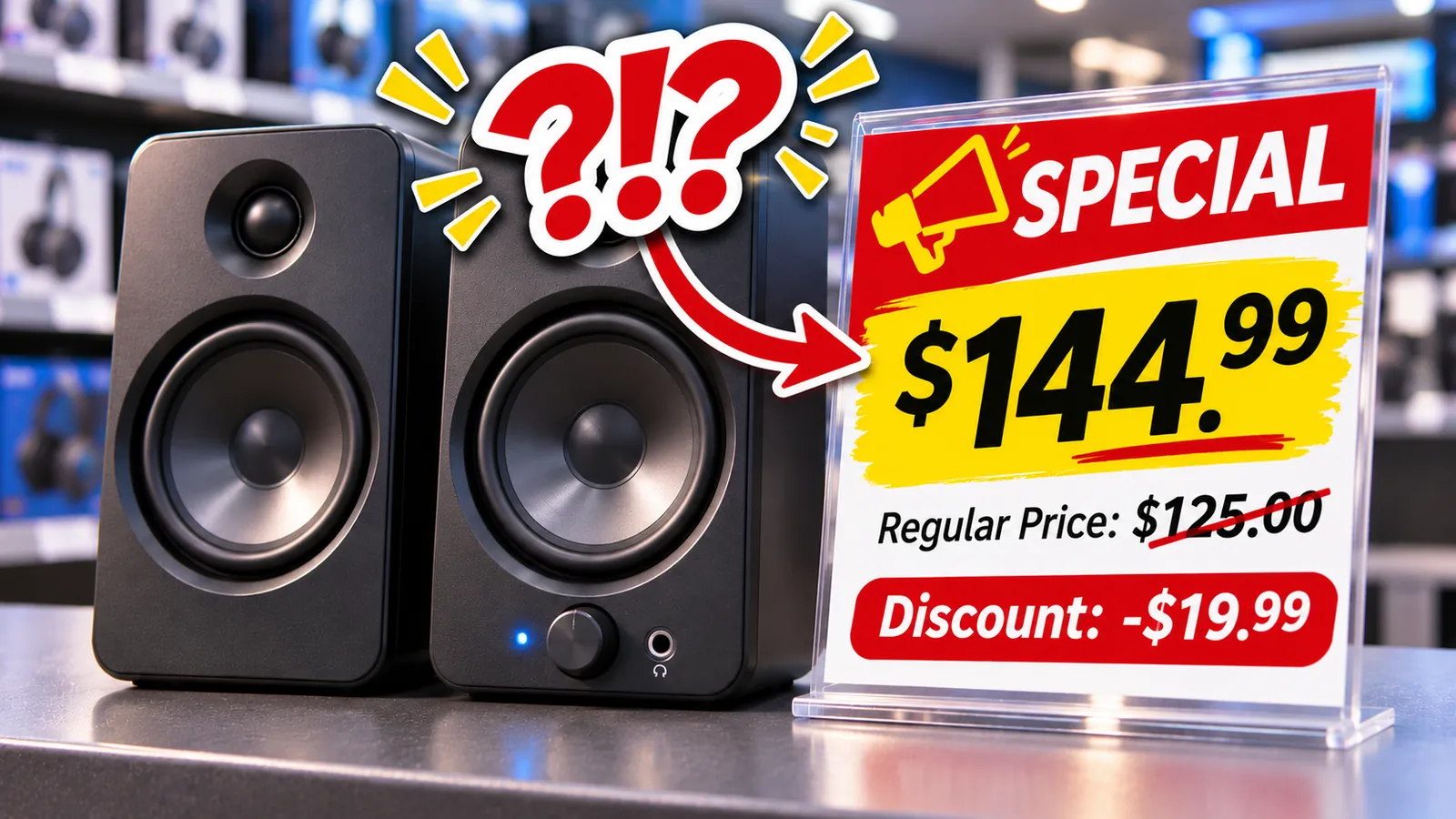
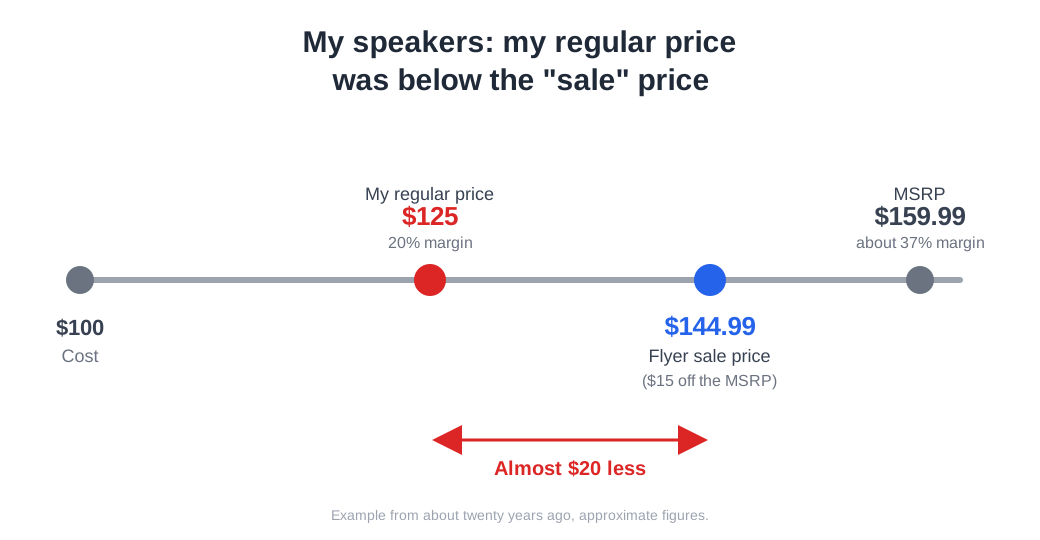
Here's an example from back then (the numbers are approximate, the concept is what matters). A pair of speakers cost me $100. I sold them for $125. Their MSRP was $159.99, which would have given a margin of about 37%. With a $15 rebate, the group advertised them on promotion at $144.99.
So my speakers at regular price were cheaper than the flyer's promotional price. That day, I realized I wasn't selling at the right margin in certain categories.
The cost-plus-margin trap
Most resellers set their price as cost plus a percentage margin. This method has two flaws.
The first: the better you are at finding good prices, the less profit you make. You find a lower cost, your selling price drops, and you gain nothing from having searched well.
The second: you run promotions without knowing it and without saying so, because you sell below MSRP. Since nobody knows it's a promotion, it can end without the customer being told. You then have to choose between frustrating the customer by raising the price, or absorbing the loss.
A service that maintains your price rules
Two years ago, one of our partners launched an e-commerce project for some of its affiliates. Their challenge: setting prices aligned with the market. We looked into the problem and launched a service that sets up the reseller's price rules and reviews them every month. Today, this service maintains more than 1,500 price rules.
It also lets you pass distributors' promotions on to your customers. You choose the manufacturers (and the categories, if you wish) whose promotions you pass on, in full or in part. If you pass on the entire promotion, your profit in dollars stays the same as at regular price. If you pass on only part of it, your profit goes up.
The promotion is limited: it lasts as long as there is inventory at your store or at the distributor. When that's no longer the case, it is removed automatically and the product goes back to its regular price. A customer who sees the promotion disappear won't be any less frustrated, but that limit also has a useful effect: it pushes the customer to decide faster.
How do you validate your selling prices?
A customer who finds your prices too high will tell you by walking away. A customer who pays too little will never say a word. So how do you know your prices are right?
Pick a product category. Compare your regular price with the MSRP, then with a recent promotion advertised by a distributor or a buying group. If your regular price is lower than their promotional price, you're in the same situation I was in with my speakers.
Not too low for you, not too high for your customer. With our price rules service, you sell at the right price, for your customers and for yourself.